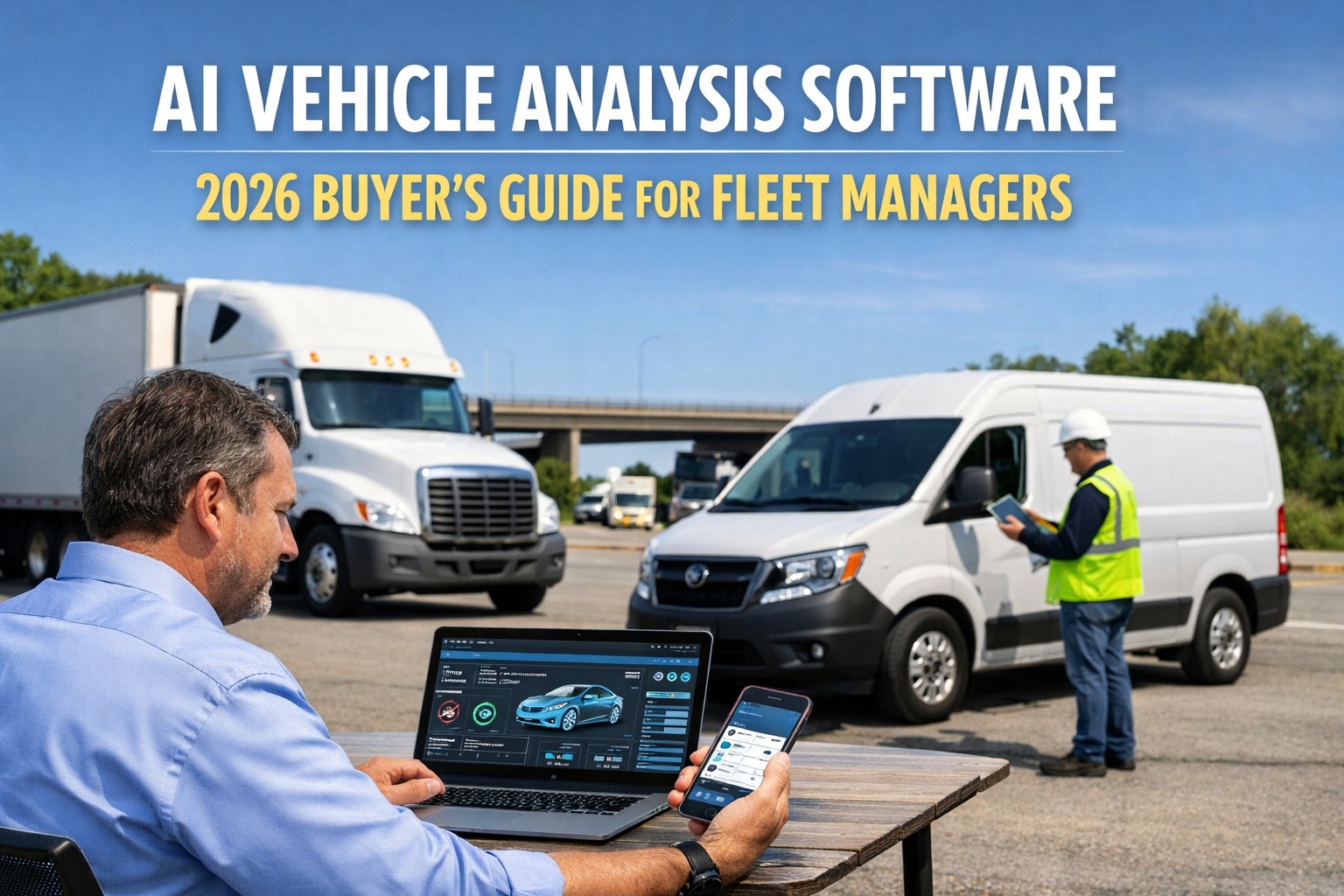
In 2026, AI vehicle analysis software is no longer an emerging technology — it is the single biggest efficiency gap in commercial fleet operations. Machine learning models now predict component failures with 85–95% accuracy, 20–45 days before traditional diagnostics raise alarms, and fleets deploying AI-powered analysis platforms are reporting 25–35% lower maintenance costs, 89% fewer preventable breakdowns, and 200–500% annual ROI. Yet 73% of fleets still run reactive maintenance programs that cost 3–5x more than planned repairs. If you are a fleet manager evaluating AI vehicle analysis software this year, the question is not whether to adopt — it is how to choose the right platform and what to compare. This 2026 buyer's guide breaks down the core capabilities that matter, the realistic pricing bands, the integration questions to ask every vendor, and the decision framework to get from "evaluating options" to "AI running on every vehicle." Start a free HVI trial and activate AI vehicle analysis across your fleet today, or book a 30-minute buyer's demo to see HVI's full AI analysis engine evaluated against your current setup.
The 2026 AI fleet landscape — where the market stands now
Before comparing platforms, it helps to understand how fast the gap is widening between AI-equipped fleets and the ones still running paper or reactive workflows.
Machine learning models now flag component failures with near-diagnostic precision, weeks before traditional fault codes trigger.
Typical lead time between AI risk flag and the date a traditional diagnostic system would detect the same problem.
Documented per-vehicle savings combining predictive maintenance, fuel optimization, and reduced breakdowns.
Most well-implemented AI analysis platforms recover their full annual cost within the first 6–7 weeks of deployment.
Nearly three-quarters of fleets operate without AI analysis — paying 3–5x more than planned maintenance costs.
Over 90% of 2026 commercial vehicles ship with factory-installed telematics — the hardware barrier no longer exists.
The 6 core capabilities — what genuine AI vehicle analysis looks like
Not all "AI fleet software" is actually AI. Here are the six capabilities that separate genuine AI vehicle analysis platforms from legacy telematics with marketing labels slapped on top.
Genuine AI analysis pulls live data from OBD-II, J1939, and telematics continuously — not polling every 15 minutes. Look for platforms that process engine temp, oil pressure, brake pressure, tyre pressure, transmission fluid temperature, battery voltage, and fuel consumption patterns simultaneously.
Generic models don't work — brake wear varies dramatically based on driver behaviour, route terrain, and load patterns. The software should establish a unique baseline for every single vehicle in your fleet and measure deviation against that baseline, not against a manufacturer spec sheet.
A real AI platform produces a dynamic health score for every vehicle — updated in real time, based on actual sensor data against learned baselines. Each at-risk component gets a failure probability percentage and estimated time-to-failure window, not a generic "check engine" light.
Alerts alone don't save money — action does. When risk crosses threshold, the platform should auto-create a prioritised work order routed to the right technician, with parts checked against inventory and scheduled during planned downtime. Zero manual triage.
AI analysis should connect maintenance data to driver behaviour — not just flag that a brake is wearing fast, but identify which driver's hard-braking pattern is causing it. Composite scoring on hard braking, acceleration profiles, cornering force, idle time, and seatbelt compliance correlated against fuel efficiency and accident risk.
The true power of AI is finding patterns no human analyst would spot. Example: simultaneous coolant temperature spikes across three trucks on the same corridor — a compound signal that flagged $187K in projected losses at a national logistics carrier. Look for correlation analysis across vehicles, not just within one.
The 10-question vendor evaluation scorecard
Every AI fleet vendor will claim they do everything. Use this scorecard to separate real capability from sales deck promises — ask these questions on every demo call.
Integration reality — can your current stack support AI analysis?
The biggest myth blocking AI adoption is that it requires a full infrastructure rebuild. In reality, most fleets are already generating the data AI needs — the integration question is about where that data flows, not whether it exists.
The 5-step buying process — from shortlist to deployment
Every fleet manager evaluating AI vehicle analysis software goes through the same five-stage buying cycle. Running it deliberately is the difference between 2 weeks to value and 6 months of stalled evaluation.
Before any vendor demo, write down the three metrics you will use to judge success in 90 days. Common targets: 30% reduction in unplanned breakdowns, 20% lower annual maintenance spend, 50% faster audit response times. Vendors who can't map to your metrics get eliminated immediately.
Run the scorecard above on every vendor you consider. If a vendor can't answer 8+ of the 10 questions with published data, remove them from consideration. Platforms that integrate with your existing telematics should always be prioritised over ones requiring hardware changes.
Insist on a 30-day pilot with 5–10 of your actual vehicles connected to live telematics. A sandbox demo shows you the vendor's cherry-picked best case; a live pilot shows you how their AI performs on your fleet's actual data patterns. Any vendor unwilling to offer this is a red flag.
At pilot end, calculate actual ROI: number of risk alerts, how many corresponded to real developing faults, estimated downtime prevented, and cost avoided. Project that against your full fleet and compare to the platform's annual cost. Target 5x+ ROI projection — below that, renegotiate or look elsewhere.
Don't go fleet-wide on day one. Deploy in phases: pilot group first, then 25% of fleet, then remaining vehicles over 60–90 days. This lets your team build operational muscle with the AI output (responding to risk alerts, closing auto-generated work orders) before managing it at full scale.
Red flags when evaluating AI vehicle analysis vendors
Genuine AI requires 2–4 weeks to build per-vehicle baselines. A vendor claiming zero calibration is running generic pattern matching, not true predictive analysis.
Ask for a named list of supported telematics providers and API documentation. Vague integration claims usually mean CSV export, not real-time data flow.
Legitimate platforms publish current accuracy benchmarks. "It will learn your fleet" without stated performance floor is a deferral of accountability.
If the vendor requires their own dashcam, telematics unit, or ECU interface, you are buying hardware lock-in, not software flexibility. Real AI layers on top of existing infrastructure.
Reputable platforms offer free tiers, 30-day pilots, or month-to-month options to prove value first. Mandatory 12-month commitments before proof are a signal of weak confidence in the product.
Vendors should publish actual case studies with real numbers — downtime reduction, cost savings, ROI payback. Marketing claims without customer evidence are a deal-breaker for any commercial purchase.
Frequently asked questions — AI vehicle analysis buyer's guide
Stop evaluating. Start operating an AI-powered fleet.
HVI's AI vehicle analysis engine integrates with your existing telematics, builds per-vehicle baselines in 2–4 weeks, and delivers failure predictions 20–45 days before traditional diagnostics would catch the problem. No new hardware, no multi-month implementation, no upfront commitment. Run the pilot. Measure the ROI. Decide for yourself.
No credit card required · Works with 200+ telematics providers · Predictions live within 72 hours